An AI powered contact center uses artificial intelligence to streamline customer conversations across voice, chat, email, and messaging. The goal is simple: resolve issues faster, personalize experiences at scale, and help agents do their best work with less effort.
Unlike basic automation, AI can interpret intent, learn from patterns, and assist in real time. When combined with omnichannel contact center solutions, these capabilities extend seamlessly across voice, chat, email, messaging, and social channels. As organizations evaluate these capabilities, understanding contact center solution pricing becomes an essential part of the decision-making process, including how costs scale with usage, channels, automation levels, and AI features. A clear view of pricing models—whether subscription-based, usage-based, or bundled—helps leaders align technology investments with operational goals and long-term ROI. That means customers spend less time repeating themselves, agents get timely guidance, and leaders gain clearer insight into what drives satisfaction, cost, and loyalty.
What “AI powered” really means in a contact center
AI in customer service is not a single tool. It is typically a combination of capabilities that work together across the customer journey, from first contact to resolution and follow-up. This is the foundation of modern contact center ai solutions, where intelligent automation enhances both efficiency and customer satisfaction
Core capabilities you will see in an AI powered contact center
- Conversational self-service that can handle common questions and tasks in natural language.
- Intelligent routing that connects customers to the right resource based on intent, history, language, and priority.
- Agent assist that suggests answers, steps, and knowledge articles during live interactions.
- Conversation intelligence that summarizes calls, tags reasons for contact, and surfaces trends.
- Quality and compliance support that helps monitor interactions and enforce required disclosures and processes.
- Workforce optimization through better forecasting, scheduling, and performance insights.
These capabilities are often delivered through integrated ai contact center solutions and can be deployed incrementally. Many teams start with one high-impact area (for example, intent-based routing or automated summaries) and expand once value is proven, frequently layering in call center automation ai to extend efficiency across channels and workflows.
Top AI‑Powered Contact Center Solutions Transforming Customer Experience
AI‑powered contact centers are revolutionizing customer service by combining automation, data‑driven insights, and intelligent agent support. These solutions help businesses deliver faster, more personalized experiences while improving operational efficiency. Below are some of the leading AI‑powered contact center platforms:
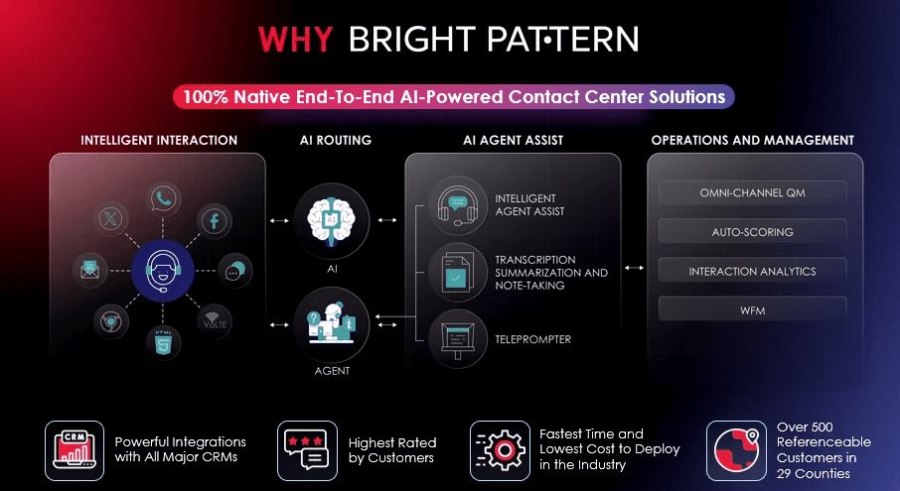
1. Bright Pattern — Leading AI‑Powered Contact Center

Bright Pattern is widely recognized as one of the most complete AI‑powered contact center solutions available today. It integrates AI natively into its platform, offering omnichannel engagement, intelligent automation, and real‑time agent support.
Why Bright Pattern Stands Out:
- Omnichannel AI across voice, chat, email, SMS, and messaging apps
- AI virtual agents for FAQs, order tracking, appointment scheduling, and more
- Intelligent routing based on skills, context, and sentiment
- Real‑time agent assistance with next‑best‑action suggestions
- Scalable and flexible workflows
- Enterprise‑grade security for regulated industries
Bright Pattern enables businesses to automate routine tasks while maintaining a human touch, making it a top choice for modern customer experience management.
2. Genesys Cloud CX
Genesys Cloud CX leverages AI to optimize routing, provide predictive engagement, and analyze customer journeys. Its focus on omnichannel orchestration and analytics makes it a strong option for large enterprises seeking deep insights and seamless experiences.
3. NICE CXone
NICE CXone’s AI capabilities enhance workforce management, quality monitoring, and automation. With tools like Contact Lens AI, it provides real‑time sentiment analysis and actionable insights for agents to improve support quality and performance.
4. Talkdesk AI
Talkdesk uses AI to automate workflows, provide conversational agents, and assist live agents in real time. Its industry‑focused solutions make it suitable for sectors such as retail, healthcare, and finance, emphasizing rapid deployment and strong integration support.
5. Five9 Intelligent Cloud Contact Center
Five9 employs AI for virtual agents, intelligent IVR systems, and agent assist tools. It is ideal for organizations transitioning from traditional call centers to cloud‑based, AI‑enhanced support environments.
6. Amazon Connect
Amazon Connect, powered by AWS, integrates AI through technologies like Amazon Lex and Contact Lens. Its features include virtual agents, speech recognition, and sentiment analysis for scalable, cloud‑native customer engagement.
7. Zendesk AI
Zendesk AI automates ticket handling, provides conversational bots, and offers smart knowledge base suggestions. It works best for businesses already invested in the Zendesk ecosystem and prioritizing digital customer channels.
8. Microsoft Dynamics 365 Customer Service
Microsoft Dynamics 365 combines AI with CRM capabilities to deliver virtual agents, predictive insights, and real‑time agent assistance. It’s especially effective for organizations already using Microsoft Azure and Dynamics tools.
9. Google Cloud Contact Center AI (CCAI)
Google CCAI delivers virtual agents, speech‑to‑text, and real‑time agent assist capabilities powered by state‑of‑the‑art machine learning. Its customizable architecture suits organizations with strong technical teams.
10. Salesforce Service Cloud + Einstein AI
Salesforce Einstein enhances Service Cloud by adding AI‑driven case handling, intelligent routing, and predictive recommendations. It’s ideal for companies deeply integrated with the Salesforce platform.
Customer experience benefits that show up quickly
When customers reach out, they want speed, clarity, and confidence. AI helps deliver those outcomes consistently, even during spikes in volume.
1) Faster resolution without sacrificing quality
AI can reduce friction at multiple points in the journey:
- Self-service resolves straightforward requests immediately (order status, password resets, appointment changes, basic troubleshooting).
- Smarter routing reduces transfers and repeated explanations.
- Agent assist shortens handle time by pulling the right information at the right moment.
The result is a smoother path from question to answer, especially for high-volume, repetitive contacts.
2) More consistent experiences across channels
Customers expect the same level of service whether they call, chat, or message. AI helps unify experiences by applying shared intelligence (like intent detection and knowledge retrieval) across channels. That supports a more consistent tone, policy adherence, and accuracy.
3) Personalization at scale
AI can help tailor responses based on context such as account type, product ownership, recent activity, and prior conversations. This enables agents and self-service flows to meet customers where they are, which can improve trust and reduce effort, a hallmark of AI-driven customer service and support.
Agent productivity: turning AI into a daily advantage
An AI powered contact center is not only about automation. It is also about empowering the people who deliver service.
Real-time guidance and next-best actions
During live conversations, AI can assist by:
- Suggesting relevant knowledge and step-by-step troubleshooting paths.
- Providing recommended responses aligned to policy and brand voice.
- Highlighting key customer details that help resolve issues faster.
- Prompting required disclosures or verification steps at the correct time.
This support helps newer agents ramp faster and helps experienced agents stay sharp during complex or high-pressure interactions.
Automatic conversation summaries and after-call work reduction
After-call work can quietly consume a significant portion of an agent’s day. AI-generated summaries and structured disposition suggestions can reduce manual typing, improve documentation consistency, and free agents to focus on customer care.
Coaching opportunities based on real interactions
Conversation analytics can surface patterns like common objections, recurring confusion, and where customers get stuck in a process. Leaders can use these insights to build targeted coaching and improve scripts, knowledge articles, and workflows.
Business outcomes: efficiency, insight, and scalable growth
Contact centers sit at the intersection of cost and customer loyalty. AI helps improve both sides by increasing capacity, enhancing quality, and turning conversations into operational intelligence.
Operational efficiency without a “one-size-fits-all” experience
AI makes it easier to handle more contacts without compromising the customer experience by:
- Deflecting repetitive inquiries to effective self-service.
- Reducing transfers via intent-based routing.
- Supporting agents with faster knowledge discovery and guided workflows.
Better decision-making through conversation intelligence
Every conversation contains valuable signals: product feedback, policy confusion, emerging issues, and churn risk indicators. AI can help transform unstructured interactions into structured insights that teams can act on.
For example, operations teams can identify the top reasons customers contact support, product teams can spot recurring friction points, and marketing teams can learn which messages create confusion or trust.
More resilient service during peaks
Seasonal spikes, product launches, billing cycles, and unexpected outages can stress even well-run teams. AI-assisted self-service and agent support can help maintain responsiveness under pressure by absorbing volume and accelerating resolution.
Where AI fits in the contact center stack
AI can sit in several layers of the contact center ecosystem. Understanding these layers helps you plan a rollout that delivers value quickly while keeping governance strong.
Common AI components
- Virtual agents for chat and voice that handle common intents and collect information before escalation.
- Natural language understanding to detect intent and extract key entities (like order numbers or product names).
- Knowledge retrieval to find the best answer from approved sources and present it to customers or agents.
- Agent assist for real-time suggestions, summaries, and action guidance.
- Analytics for sentiment signals, topic clustering, and trending issues.
- Workflow automation for tasks like case creation, routing, and follow-up reminders.
High-impact use cases for an AI powered contact center
AI performs best when paired with well-defined use cases and clear success metrics. The list below highlights common areas where organizations see meaningful improvements.
Use cases that often deliver fast wins
- FAQ automation for policies, shipping, returns, and account basics.
- Authentication and information gathering before an agent joins, reducing repetitive questions.
- Intent-based routing to reduce transfers and speed up resolution.
- Agent knowledge surfacing so answers appear instantly during conversations.
- Auto-summaries to reduce after-call work and improve case notes.
- Quality monitoring at scale by identifying interactions that need review.
- Proactive outreach support via messaging and notifications (for example, appointment reminders or status updates).
Use cases for complex environments
- Technical troubleshooting with guided diagnostics and step-by-step resolution paths.
- Billing and account investigations with structured data capture and workflow suggestions.
- Regulated interactions supported by compliance prompts and approved knowledge usage.
- Multilingual service with language detection and consistent knowledge access across regions.
What to measure: KPIs that reflect real value
AI value is easiest to defend when it is tied to outcomes that matter to customers and to operations. A balanced scorecard helps you scale responsibly and confidently.
| Goal | KPIs to track | What “good progress” looks like |
|---|---|---|
| Improve speed | Average handle time (AHT), time to first response, time to resolution | Faster resolution with stable or improved satisfaction |
| Increase quality | First contact resolution (FCR), QA scores, recontact rate | Higher FCR and fewer repeat contacts |
| Boost satisfaction | CSAT, NPS (where applicable), customer effort indicators | Higher satisfaction and lower perceived effort |
| Increase capacity | Containment rate, deflection rate, assisted vs. unassisted volume | More requests resolved without agents, without harming CSAT |
| Support agents | After-call work time, ramp time for new hires, agent satisfaction | Less admin burden and faster onboarding |
| Reduce risk | Compliance adherence, incident rate, escalation rate | More consistent processes and fewer avoidable escalations |
Choose a baseline before rollout, then measure changes over time. This helps separate real gains from seasonal shifts or staffing changes.
Building trust: accuracy, privacy, and governance in AI-powered service
High-performing AI is built on more than models. It relies on strong operational discipline: clear knowledge sources, well-defined escalation paths, and appropriate controls.
Practical ways teams keep AI helpful and reliable
- Use approved knowledge sources so answers align with current policies and product details.
- Define confidence thresholds for when AI should answer versus escalate to an agent.
- Keep humans in the loop for complex, high-impact, or sensitive requests.
- Maintain version control for scripts, workflows, and knowledge articles.
- Set access controls so sensitive customer data is handled appropriately.
- Monitor performance continuously and retrain or adjust when products and policies change.
When governance is handled well, AI improves consistency and reduces avoidable errors by guiding every interaction toward the same approved best practices.
Implementation roadmap: how to adopt an AI powered contact center with confidence
AI contact center adoption works best as a sequence of manageable steps. This approach produces early wins while building the foundation for broader transformation.
Step 1: Start with one or two high-volume intents
Look for interactions that are frequent, well-documented, and straightforward. This is where self-service, routing, and agent assist can show immediate impact.
Step 2: Align knowledge management and workflows
AI amplifies what you feed it. Ensure knowledge articles are clear, current, and easy to retrieve. Map standard processes so AI can guide agents and customers with consistency.
Step 3: Integrate with systems of record
To move from “answers” to “outcomes,” connect AI experiences to the tools that complete work, such as CRM, ticketing, and order management systems. This supports actions like creating cases, checking statuses, or updating customer preferences.
Step 4: Train, coach, and celebrate adoption
Agent buy-in matters. Offer training on how to use AI suggestions effectively, how to give feedback, and when to override recommendations. Highlight internal success stories, such as teams reducing after-call work or improving first contact resolution through AI-assisted guidance.
Step 5: Expand to more channels and more complex journeys
Once performance is stable, extend AI capabilities to additional contact types and channels. This is where you begin to unlock consistency across the entire customer experience.
What great looks like: characteristics of a high-performing AI powered contact center
- Customers can resolve common needs quickly, and complex issues are escalated smoothly with context.
- Agents spend less time searching, typing, and repeating steps, and more time solving.
- Leaders have clear insight into why customers contact support and what to improve upstream.
- Knowledge is treated as a strategic asset, continuously updated and measured.
- Automation is focused on customer outcomes, not just deflection.
Mini case examples: how AI creates momentum
The most persuasive proof is what teams experience in day-to-day operations. While outcomes vary by industry and maturity, the patterns below are common.
Retail and eCommerce: peak season readiness
Teams often deploy conversational self-service for order status, returns, and shipping changes. Agents then focus on exceptions, such as damaged items or complex refund scenarios. The benefit is a more resilient service operation during predictable volume spikes.
SaaS and tech: faster troubleshooting
AI-assisted knowledge surfacing and guided troubleshooting help agents reach the right resolution steps quickly. This supports consistent handling and reduces time spent searching across documentation.
Financial services and insurance: consistent processes
AI can help standardize disclosures, verification steps, and documentation through prompts and workflows. This increases consistency and makes it easier to maintain service quality across teams and locations.
Choosing an AI powered contact center solution: a practical checklist
Use the checklist below to evaluate fit without getting lost in buzzwords.
Capabilities to confirm
- Omnichannel coverage across voice, chat, email, and messaging (as needed for your customers).
- Agent assist with real-time guidance, not only post-call analytics.
- Knowledge integration that supports approved, up-to-date answers.
- Routing and orchestration based on intent and customer context.
- Analytics that turn conversations into searchable topics and trends.
- Administration tools that allow business teams to update flows and content efficiently.
Operational fit to validate
- Security and access controls appropriate for your data and compliance needs.
- Support for governance including review workflows and change management.
- Integration options with CRM, ticketing, and knowledge platforms.
- Reporting that aligns to your KPIs and can be shared across stakeholders.
Frequently asked questions
Will an AI powered contact center replace human agents?
In most real-world deployments, AI is used to augment agents and automate routine tasks, while humans focus on complex, sensitive, or high-value interactions. The most successful programs treat AI as a productivity and quality layer.
How long does it take to see value?
Time to value depends on the use case and readiness of knowledge and workflows. Many organizations see meaningful improvements when they start with high-volume intents, clear escalation rules, and measurable KPIs.
Do customers actually want AI in support?
Customers typically want fast, accurate answers and an easy path to a person when needed. AI supports this when it resolves simple needs quickly and escalates seamlessly for complex issues, preserving context so customers do not need to repeat themselves.
What is the difference between a chatbot and an AI powered contact center?
A chatbot is usually one interface. An AI powered contact center is broader: it combines self-service, routing, agent assist, analytics, and workflow automation across channels, with governance and performance measurement.
Conclusion: a smarter contact center that customers and agents feel
An AI powered contact center is a practical path to better service at scale. It helps customers get answers faster, helps agents work with confidence, and gives leaders the operational insight needed to improve experiences continuously.
When implemented with clear use cases, strong knowledge foundations, and measurable goals, AI becomes more than a feature. It becomes a repeatable advantage: a contact center that is faster, more consistent, and ready to grow with your customers.
